 how-to
How to Improve Balance for Seniors: 7 Exercises That Work
Table of Contents
- Why Balance Declines With Age and What You Can Do
- Safety Precautions Before Starting Balance Exercises
- Balance Exercises for Seniors: Step-by-Step Progressions
- Neuro-Fitness for Seniors: Building Proprioception and Coordination
- Rock Steady Boxing Benefits for Fall Prevention and Stability
- Home Environment Modifications to Support Your Balance Training
- Overcoming the Fear of Falling: Psychological and Physical Strategies
- Common Mistakes to Avoid When Building Senior Balance
- Frequently Asked Questions
Last Updated: September 30, 2026
Why Balance Declines With Age and What You Can Do
Balance naturally declines as we age, but understanding how to improve balance for seniors can help prevent falls and maintain independence. The inner ear, muscles, and nervous system work together to keep us upright. When any of these systems weaken, falls become more likely.
Several changes happen as we get older. Muscle strength decreases. Proprioception (your body's ability to sense where it is in space) gets worse. Vision changes. Reaction time slows down.
The good news? Learning how to improve balance for seniors is possible at any age through targeted exercises that rebuild strength and coordination. Targeted exercises rebuild strength and coordination. Research shows that consistent balance training reduces fall risk significantly (pubmed.ncbi.nlm.nih.gov). Targeted exercises rebuild strength and coordination. Research shows that consistent balance training reduces fall risk significantly.
Falls aren't inevitable. They're preventable with the right approach.
Safety Precautions Before Starting Balance Exercises
Before you begin any new exercise program, take these steps:
Talk to your doctor first. Tell them about your current fitness level and any health conditions. This is especially important if you have heart problems, joint issues, or dizziness.
Start slowly. Don't jump into advanced exercises. Your body needs time to adapt.
Use proper footwear. Wear shoes with good grip and support. Avoid socks alone on slippery floors.
Clear your exercise space. Remove tripping hazards. Make sure you have room to move safely.
Have something sturdy nearby. A chair, counter, or wall gives you something to hold if you lose balance.
Stay hydrated. Drink water before, during, and after exercise. Dehydration can cause dizziness.
Watch for warning signs. Stop if you feel dizzy, short of breath, or experience chest pain. Rest and consult your doctor.
Balance exercises work best when done safely. Taking these precautions protects you while you build strength.
Balance Exercises for Seniors: Step-by-Step Progressions
Level 1: Static Balance Foundations
Static balance means staying still while standing. These foundational exercises build the basic stability your body needs.
Wall stands are the safest starting point. Stand with your back against a wall, feet about 6 inches away from the wall. Keep your feet hip-width apart. Hold this position for 30 seconds. Rest. Repeat 3 times. Your body learns to maintain an upright posture without movement.
Chair holds come next. Stand behind a sturdy chair. Place both hands on the back. Stand for 30 seconds. Gradually reduce hand pressure as you feel more stable. This teaches your body to support itself with less external help.
Tandem stance (feet in a line) challenges balance more. Stand with one foot directly in front of the other, heel to toe. Hold onto a chair with fingertips only. Stay for 10-20 seconds. Switch feet. Do this 3 times on each side. This position mimics the balance needed for walking.
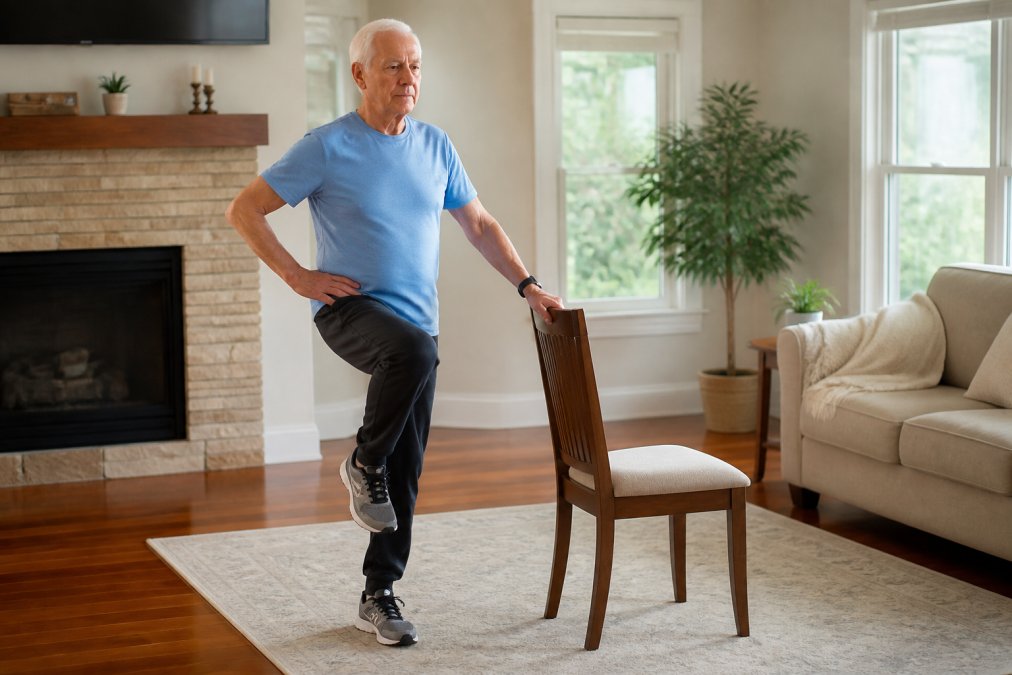
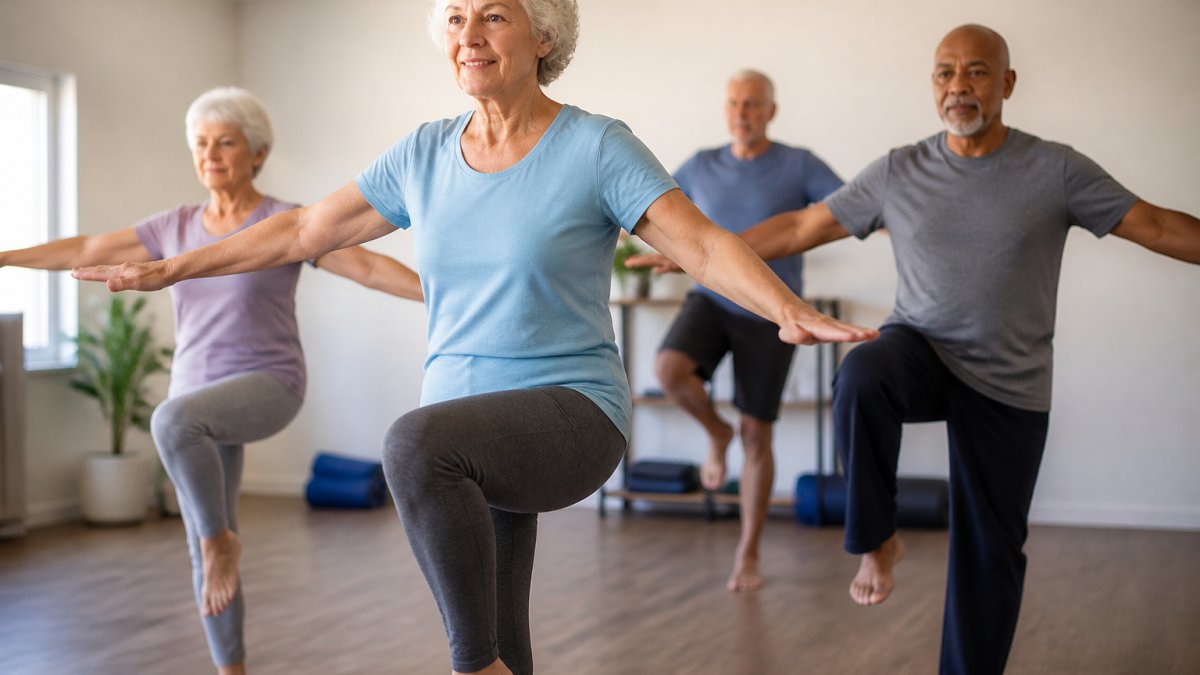
Single-leg stance is the ultimate static balance test. Stand on one leg while holding a chair. Keep the other foot slightly lifted. Hold for 10-30 seconds. Switch legs. Work up to holding without touching the chair. This builds the core strength and proprioception needed for daily activities.
Progress slowly through these levels. Spend at least 1-2 weeks on each exercise before advancing.
Level 2: Dynamic Balance and Weight Shifting
Dynamic balance involves movement. Your body learns to shift weight and adjust position.
Weight shifting teaches your body to move side to side safely. Stand with feet hip-width apart. Hold a chair for balance. Slowly shift your weight to the right foot. Feel the weight transfer. Shift back to center. Shift to the left. Do this 10 times. Move slowly and deliberately.
Heel-to-toe walking builds coordination. Walk in a straight line, placing the heel of one foot directly in front of the toes of the other foot. Walk 20 feet this way. This mimics a sobriety test and trains the brain and feet to work together.
Marching in place strengthens legs while maintaining balance. Stand near a chair. Lift one knee up, then the other, like marching. Do this slowly for 30 seconds. Rest. Repeat 3 times. This movement activates the muscles needed to walk and climb stairs.
Step-ups use a low step or stair. Stand facing the step. Place one foot on the step. Push through that foot to step up. Step back down with control. Do 8 repetitions on each leg. This builds the leg strength needed to navigate stairs and uneven ground.
These exercises take 10-15 minutes daily. They're more challenging than Level 1, so your body adapts faster.
Level 3: Advanced Stability Challenges
Advanced exercises demand more from your balance system. Do these only after mastering Levels 1 and 2.
Single-leg stance with movement combines static and dynamic balance. Stand on one leg. Reach your other leg forward, then back. Do 10 reaches. Switch legs. This trains your body to stay stable while moving a limb.
Get Started Today at NO RISK! →
Tandem walking (walking heel-to-toe) is more challenging than simple heel-to-toe walking. Walk in a straight line with one foot directly in front of the other. Move slowly. This requires intense focus and coordination.
Eyes-closed balance removes visual input, forcing your proprioceptive system to work harder. Stand near a chair. Hold it lightly. Close your eyes. Try to balance for 10-20 seconds. Open your eyes if you feel unsafe. This dramatically improves your body's internal balance awareness.
Reaching exercises while balancing add complexity. Stand on one leg. Reach your arm forward, to the side, and behind you. Return to center. Do 5 reaches in each direction. Switch legs. This mimics real-world movements like picking up objects or reaching for items.
Advanced exercises should be done 3-4 times per week with at least one rest day between sessions. Your muscles need recovery time to grow stronger.
Neuro-Fitness for Seniors: Building Proprioception and Coordination
Proprioception is your body's ability to know where it is in space without looking. It's the reason you can walk without watching your feet. As we age, proprioception declines. Training it restores balance and confidence.
Proprioceptive exercises challenge your sensory system. They train the connections between your muscles, joints, and brain.
Balance board exercises are excellent for proprioception. Stand on a balance board or foam pad. Your body must constantly micro-adjust to stay upright. Start by holding a chair. Work toward balancing without support. Even 2 minutes daily improves proprioception measurably.
Tai Chi is a gentle form of movement training that builds proprioception naturally. This ancient practice involves slow, controlled movements that emphasize weight shifting and balance. Many seniors find Tai Chi easier to stick with than traditional exercise because it feels meditative rather than strenuous. Classes are widely available and can be adapted for any fitness level.
Coordination drills train your brain and body to work together. Try touching your nose with your index finger while standing on one leg. Or tap your foot and pat your head at different rhythms. These seemingly simple tasks activate multiple brain regions and improve neuromuscular control.
The key to neuro-fitness is consistency.
Rock Steady Boxing Benefits for Fall Prevention and Stability
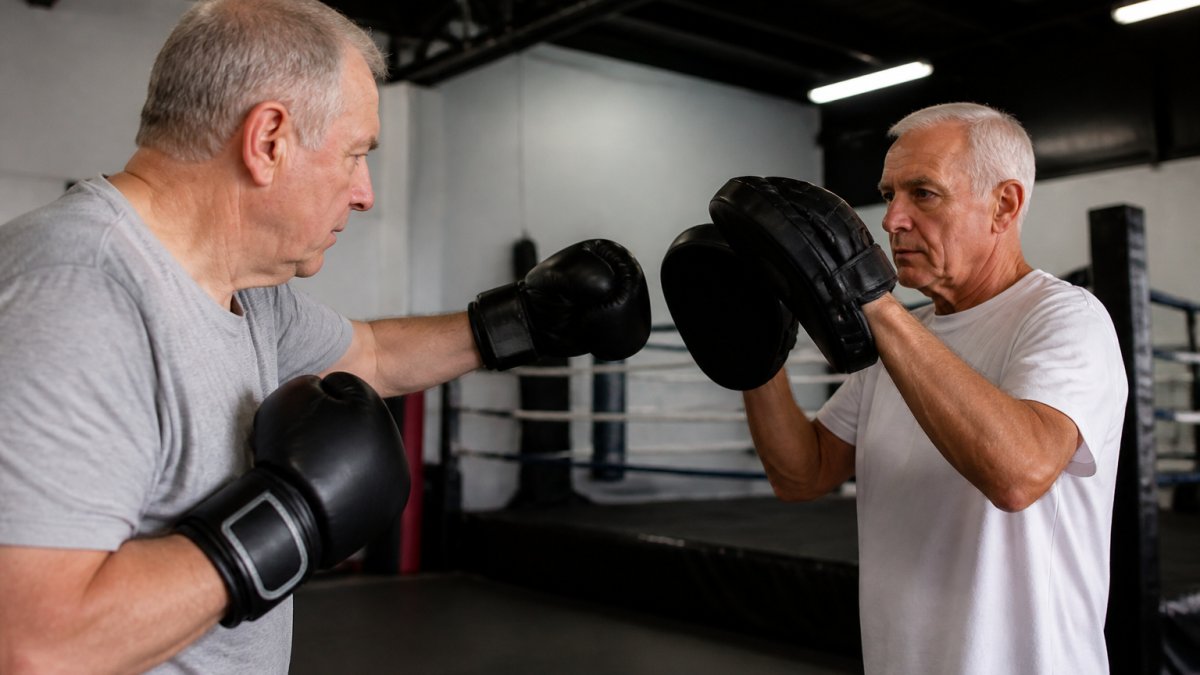
Rock Steady Boxing is a specialized fitness program designed for people with neurological conditions, including Parkinson's disease (rocksteadyboxing.org). It uses boxing movements to improve balance, coordination, and confidence.
The program combines footwork, hand-eye coordination drills, and bag work. These movements activate the motor cortex of the brain in ways that standard exercise doesn't.
Battenberg's offers specialized Rock Steady Boxing training led by experienced coaches. The program isn't about fighting, it's about using boxing movements to rebuild neural pathways and restore physical function. Participants work at their own pace in a supportive environment.
Benefits include improved balance, faster reaction times, better coordination, and reduced fear of falling. Many participants report increased confidence in daily activities like walking, climbing stairs, and navigating crowded spaces.
If you or a loved one is dealing with a neurological condition, Rock Steady Boxing offers a proven approach to maintaining independence and slowing disease progression.
Home Environment Modifications to Support Your Balance Training
Your home environment affects your fall risk. Simple changes make a big difference.
Remove tripping hazards. Secure loose rugs. Pick up clutter from walkways. Coil electrical cords. Store items at waist height, avoid bending down or reaching up frequently.
Improve lighting. Install bright lights in hallways, bathrooms, and staircases. Use nightlights in bedrooms and bathrooms.
Overcoming the Fear of Falling: Psychological and Physical Strategies
Many seniors develop a fear of falling after one fall. This fear is real and understandable. But it can become self-defeating, fear causes people to move less, which weakens muscles and actually increases fall risk.
Breaking this cycle requires both physical and psychological approaches.
Common Mistakes to Avoid When Building Senior Balance
Many seniors make mistakes that slow progress or increase injury risk. Knowing these helps you avoid them.
Frequently Asked Questions
Can balance be restored in seniors, or is it permanent decline?
Balance can absolutely be restored and improved at any age. The key is consistent, progressive training that challenges your proprioception and strengthens your lower body. Studies show that seniors who engage in regular balance exercises see measurable improvements in stability and coordination within 4-6 weeks. Even small daily practice sessions yield results when done correctly with proper progression.
What role does neuro-fitness for seniors play in fall prevention?
Neuro-fitness trains your nervous system to respond faster and more accurately to balance challenges. It strengthens the communication pathways between your brain, muscles, and inner ear, the systems responsible for detecting movement and maintaining stability. This neuromuscular control is critical for catching yourself before a fall happens. Programs that combine neuro-fitness with strength training reduce fall risk significantly.
How long should a 70-year-old be able to balance on one foot?
A healthy 70-year-old should aim for 20-30 seconds of single-leg balance without losing stability or needing to touch down. If you can't hold 10 seconds yet, that's your starting point, progress gradually over weeks. Balance ability varies widely based on fitness level and prior training, so focus on your own improvement rather than a strict benchmark. Consistency matters far more than raw duration.
Are boxing-based workouts safe for improving senior balance?
Yes, when taught properly with appropriate progression. Boxing-based programs like Rock Steady Boxing are specifically designed for seniors and those with neurological conditions. They build reactive balance, hand-eye coordination, and lower body strength through controlled movements. Always work with an instructor trained in senior fitness to ensure proper form, appropriate intensity, and injury prevention. Start at your fitness level and advance gradually.