 how-to
Martial Arts for Focus in Kids: A Parent's Guide
Table of Contents
- How Martial Arts Improves Focus and Concentration
- Martial Arts for ADHD Kids: What Parents Need to Know
- Top Martial Arts Styles That Build Focus in Children
- How to Improve Child Concentration Through Class Structure
- Martial Arts Class Structure for Focus and Discipline
- Choosing a Quality Martial Arts School: Red Flags and Green Lights
- Getting Started: What to Expect in Your Child's First Classes
- Frequently Asked Questions
Last Updated: September 27, 2026
How Martial Arts Improves Focus and Concentration
Martial arts for focus in kids works by training the brain to filter distractions and lock onto a single goal, rewiring how children process attention and self-control.
During training, kids follow precise instructions and execute movements in sequence, strengthening executive function, the mental system controlling attention, planning, and impulse control. The structured dojo environment prevents distractions; students can't think about homework or recess. They're fully present.
Martial arts combines rhythmic movement with mental focus. When a child practices a form or kata, both brain hemispheres engage simultaneously, the left handling sequence and rules, the right managing spatial awareness. This dual engagement creates stronger neural pathways for sustained attention.
Activities requiring sustained concentration, like martial arts, build the same neural networks used in academic focus. A child who maintains a fighting stance while executing combinations trains their brain for classroom focus.
Consistent training develops a habit of focus. Kids show up at the same time each week, follow the same warm-up sequence, and work toward belt progression. This predictability teaches the brain that focus is expected and rewarded.
Martial Arts for ADHD Kids: What Parents Need to Know
Martial arts for ADHD kids offers a structured environment where hyperactivity becomes an asset instead of a liability.
Children with ADHD struggle to filter irrelevant information and sustain attention (the CDC). A typical classroom overwhelms with fluorescent lights, noise, and visual clutter. A dojo differs: controlled space, clear instructor voice, explicit expectations.
Here's what works:
- Clear rules and immediate feedback. In martial arts, a child knows instantly whether they executed a technique correctly. There's no ambiguity. This immediate feedback loop helps ADHD brains stay engaged.
- Physical outlet for excess energy. ADHD kids often have high energy levels. Martial arts channels that energy into productive movement. A child who would fidget in a classroom can burn that energy through kicks and punches.
- Structured progression. Belt systems provide concrete goals. A child works toward a specific achievement. Progress is visible and tangible.
- One-on-one correction. Good instructors work with each student individually. This personalized attention helps ADHD kids feel seen and understood.
Finding an instructor who understands neurodevelopmental differences is key. Not every dojo is equipped to teach ADHD kids effectively; you need someone patient, experienced, and willing to modify instructions.
At Battenberg's, our instructors are trained to work with children who have attention challenges. We recognize that focus looks different for every child and adapt accordingly.
Top Martial Arts Styles That Build Focus in Children
Not all martial arts styles develop focus equally. Some emphasize competition; others prioritize discipline and mental control. For building concentration, certain styles are more effective.
Taekwondo
Taekwondo emphasizes discipline, respect, and structured progression. Students follow a clear belt ranking system. Each belt level requires mastery of specific techniques and forms before advancement.
Forms practice builds focus. A child must memorize a choreographed sequence, execute each movement with precision, and maintain mental focus for 2-3 minutes, significant training for children with attention challenges.
Taekwondo teaches breathing techniques tied to movement. Controlled breathing activates the parasympathetic nervous system, calming the brain (The relaxation effect of prolonged expiratory breathing). This mind-body connection strengthens focus over time.
The structured class format supports attention development. Classes follow the same sequence every session, helping ADHD brains settle into focus mode.
Boxing
Boxing is one of the most mentally demanding martial arts. A boxer must track an opponent's movements, predict their next action, and respond in real time, requiring intense concentration.
Boxers practice footwork combinations repeatedly until automatic, freeing mental bandwidth for higher-level thinking, anticipation, and strategy.
Boxing training includes heavy bag work, mitts, and sparring, each requiring different focus types. This variety keeps the brain engaged and prevents boredom.
Get Started Today at NO RISK! →
For kids with restless energy, boxing is ideal. It burns calories, builds confidence, and demands total mental engagement.
Jujitsu
Jujitsu is sometimes called "physical chess." Every movement requires problem-solving: escaping holds, applying pressure correctly, and adapting when opponents counter.
This constant problem-solving builds focus differently than forms-based martial arts. Children learn principles and apply them in real time, staying mentally present as each second brings a new puzzle.
Jujitsu emphasizes ground work, requiring intense body awareness and spatial reasoning. Kids develop proprioceptive awareness, understanding where their body is in space.
Grappling teaches self-regulation.
How to Improve Child Concentration Through Class Structure
The way a martial arts class is structured determines whether it builds focus or just burns energy. Not all classes are designed equally.
Martial Arts Class Structure for Focus and Discipline
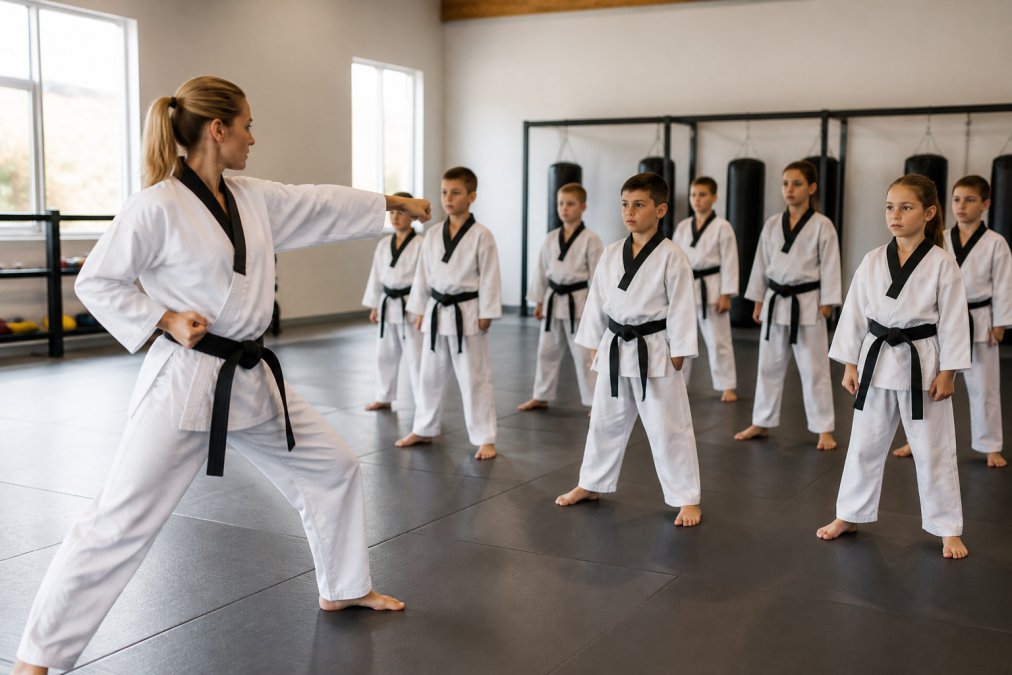
A typical focus-building class follows this pattern:
- Opening ritual (3-5 minutes). Students bow, stand at attention, and center themselves. This signals a transition from regular life to training mode.
- Warm-up (5-10 minutes). Stretching, light cardio, breathing exercises. This prepares the body and calms the nervous system.
- Technique instruction (15-20 minutes). The instructor teaches one or two techniques in detail. Students practice with a partner or alone.
- Drilling (10-15 minutes). Repetitive practice of techniques. This builds automaticity and strengthens neural pathways.
- Application (10-15 minutes). Students apply techniques in controlled sparring or forms practice.
- Cool-down (5 minutes). Stretching, breathing, reflection. This brings the nervous system back to baseline.
This structure matches how the brain manages attention: the opening ritual creates a mental boundary, warm-up preps the nervous system, instruction demands focus, drilling builds automaticity, application tests understanding, and cool-down allows integration.
Choosing a Quality Martial Arts School: Red Flags and Green Lights
Not every dojo will help your child develop focus. Some prioritize competition over discipline. Others are more interested in enrollment numbers than teaching quality.
Red flags to watch for:
- Pressure to sign long contracts. Quality schools don't need to lock you in. They let you try classes first.
- Expensive belt tests. If the dojo charges significant fees for belt advancement, focus is secondary to revenue.
- Instructors who seem disengaged. A good instructor knows each student's name and learning style. They're present and attentive.
- Chaotic class environment. If kids are running around unsupervised or the instructor is yelling to maintain control, the environment won't support focus development.
- No clear progression system. Kids need to see how they're advancing. A good dojo has clear belt requirements and transparent advancement criteria.
Green lights to look for:
- Trial classes offered. A confident school lets you observe and try before committing.
- Individualized attention. The instructor corrects each student specifically. They don't use generic praise.
- Clear belt requirements. You can see exactly what your child needs to learn to advance.
- Mixed-age classes with age-appropriate modifications. A good dojo teaches 6-year-olds and 16-year-olds together but adjusts expectations.
- Emphasis on respect and discipline. The school culture values self-control, not aggression.
- Experience with different learning styles. Instructors mention working with ADHD kids, kids with anxiety, or kids who struggle in traditional schools.
Getting Started: What to Expect in Your Child's First Classes
The first few classes are crucial. Your child's experience will determine whether they stick with martial arts or quit.
Here's what typically happens:
- Introduction and expectations. The instructor explains the rules: respect the dojo, listen to instructions, do your best.
- Basic stance and movement. Your child learns how to stand properly and move with control.
- Simple technique. A basic kick or punch, broken into steps.
- Practice with feedback. Your child practices while the instructor watches and corrects.
- Cool-down and encouragement. The class ends with praise for effort and a clear explanation of what they'll learn next week.
| Expectation | Reality |
|---|---|
| My child will be perfect immediately | Progress takes weeks; mistakes are normal |
| Classes are all fighting | Most time is spent on technique, forms, and discipline |
| My child will get hurt | Controlled training minimizes injury; instructors prioritize safety |
| One class will fix attention issues | Consistent training over months builds lasting change |
| My child needs to be athletic | Martial arts builds athleticism; beginners start at zero |
Frequently Asked Questions
Which martial art is best for kids who struggle with focus?
Taekwondo and boxing are particularly effective for children with focus challenges. Taekwondo emphasizes forms and structured sequences that build attention span, while boxing develops hand-eye coordination and requires sustained concentration on technique. The best choice depends on your child's learning style and interests. Structured programs that include neuro-training components, designed specifically to develop brain function during critical developmental years, offer additional cognitive benefits beyond traditional martial arts instruction.
At what age can children start martial arts to see benefits in focus?
Children as young as 4 years old can begin martial arts training designed for their developmental stage. Programs specifically created for ages 4-6 introduce foundational discipline, body awareness, and attention skills through age-appropriate instruction. These early years are critical for cognitive development, making specialized programs that include neuro-training particularly valuable. Older children (7+) can progress to more complex techniques and see measurable improvements in school concentration within 8-12 weeks of consistent training.
How does martial arts training improve concentration in children with ADHD?
Martial arts addresses ADHD symptoms through structured routine, clear goal-setting, and immediate feedback on performance. The repetitive nature of forms and techniques builds executive function, the mental skills that control attention and impulse control. Belt progression systems provide concrete motivation and visual progress tracking. Classes emphasize instruction following and body awareness, which strengthens self-regulation. Children with ADHD benefit from the physical outlet combined with mental discipline required in martial arts, making it an effective complement to other ADHD management strategies.
What makes a quality martial arts school different from a 'McDojo'?
Quality schools focus on skill development and character building rather than rapid belt advancement and membership sales. Look for instructors who assess each child's individual needs, provide detailed feedback, and maintain small class sizes. Quality programs use evidence-based teaching methods and may include specialized training like neuro-training for young children. Avoid schools that promote excessive belt testing fees, guarantee rapid advancement, or lack certified instruction. Ask about instructor credentials, class observation policies, and whether the school emphasizes discipline and respect alongside physical technique.