 blog
Neuro Fitness Exercises for Seniors: 7 Brain-Body Workouts
Table of Contents
- What Neuro Fitness Exercises Do for Senior Brain Health
- Memory Exercises for Seniors to Strengthen Recall
- Balance Exercises for Seniors to Prevent Falls
- Dual-Task Exercises for Seniors: Combining Movement and Cognition
- Chair Exercises for Seniors with Limited Mobility
- Boxing-Based Neuro Fitness for Cognitive and Physical Gains
- Getting Started: Safety, Progression, and Tracking Progress
- Frequently Asked Questions
Last Updated: October 21, 2026
What Neuro Fitness Exercises Do for Senior Brain Health
Neuro fitness exercises for seniors combine movement and cognitive challenges to strengthen body and mind, targeting balance, coordination, memory, and focus at once. Research shows pairing physical activity with mental tasks beats walking or stretching alone. At Battenberg's, our neuro fitness programs combine boxing-based training with cognitive exercises.
Memory Exercises for Seniors to Strengthen Recall
Memory exercises train your brain to hold and retrieve information faster.
Start with word recall: say 10 common items out loud (apple, chair, book, lamp, key, cup, hat, shoe, pen, ring), wait 30 seconds, then write down as many as you remember. Do this 3 times per week and track your recall. The alphabet game works too: pick a category like animals or foods and name something for each letter.
Pair these with physical movement: stand during word recall or walk slowly during the alphabet game. Movement increases blood flow to the brain and makes memory work stick longer.
Balance Exercises for Seniors to Prevent Falls
Balance exercises for seniors reduce fall risk by strengthening the systems that keep you upright. Falls are the leading cause of injury for older adults, and prevention starts with targeted practice (the CDC).
The single-leg stand is foundational: near a wall or counter, lift one foot and hold 10-15 seconds, 5 repetitions per leg, 3 times per week, building ankle and hip strength that prevents stumbles.
Add these twice per week. Balance improves within 4-6 weeks with consistent practice, challenge yourself just enough to feel unstable but safe.
Dual-Task Exercises for Seniors: Combining Movement and Cognition
Dual-task exercises are where neuro fitness becomes powerful: you move while thinking, training the brain to handle multiple demands. Walking while talking, carrying groceries through a doorway, or stepping over a curb while reading a sign all divide attention between movement and cognition, dual-task training practices that skill deliberately.
Movement and mental work compete for the same brain resources, especially attention and working memory. Practicing both at once builds the ability to shift and sustain attention under load.
A Step-by-Step Dual-Task Progression
Start with a stable base and add one cognitive layer at a time.
Level 1: Seated or supported marching with a simple verbal task. Sit upright in a sturdy chair or stand holding a counter.
Level 2: Supported standing march with a counting task. Stand near a wall or counter.
Level 3: Walking with a serial subtraction task. Walk at a comfortable pace along a clear hallway while counting backward from 100 by 7s (100, 93, 86, 79...).
Level 5: Movement sequence with instruction-following. Stand with feet shoulder-width apart.
A Practical Dual-Task Session
A complete 12-minute session: 2 minutes of seated marching with category naming as a warm-up, 3 cycles of Level 3 walking with serial subtraction, 3 cycles of Level 4 category switching, 2 minutes of Level 5 sequencing, and 2 minutes of slow supported marching to cool down. Rest as needed and stop if you feel dizzy or unsteady.
Safety Adaptations
Dual-task work raises fall risk if it is too hard or practiced in an unsafe setting. Adaptations:
- Mobility limitations: Start seated, seated marching with a verbal task still delivers the cognitive-motor challenge without standing balance demand.
- Balance concerns: Stand at a counter or use a sturdy chair, keeping one hand on the support until the movement feels automatic.
- Vision changes: Choose verbal tasks rather than visual ones, and keep the walking path clear and well lit.
- Chronic conditions: With heart or lung conditions, keep movement low intensity and monitor breathing. Consult your clinician before adding cognitive load if you have a history of dizziness or falls.
Why This Matters More Than Single-Task Practice
Real life is almost never single-task: answering a question while walking, remembering a phone number while cooking, or reacting to a curb while talking all require divided attention. Improvements typically show up first in confidence during daily activities, then in measured task accuracy. Track both, correct answers during a walking task and how steady you felt.
Chair Exercises for Seniors with Limited Mobility
Chair exercises for seniors provide a safe way to train when standing is difficult or unsafe.
Seated marching is simple but effective: sit upright in a sturdy chair, lift one knee toward your chest, lower it, and alternate for 30 seconds. Rest 30 seconds.
Get Started Today at NO RISK! →
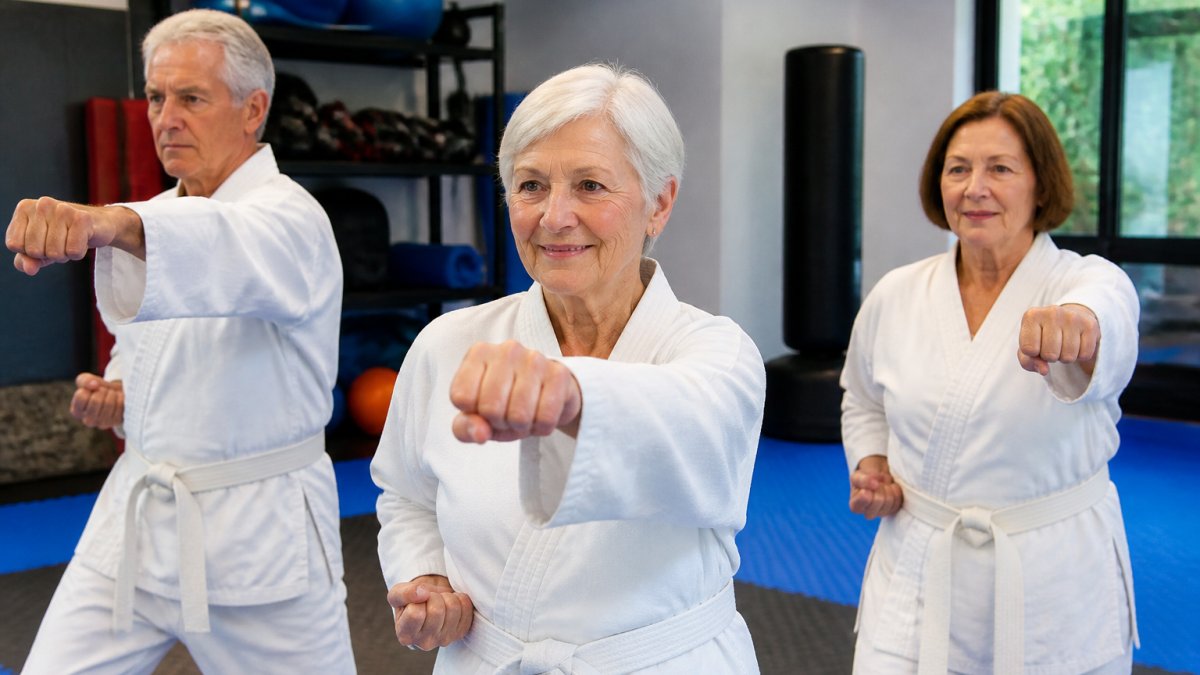
Seated boxing builds arm strength and shoulder stability: sit upright, make fists, and throw punches forward with each arm for 30 seconds at a comfortable pace.
These exercises work 2-3 times per week and are especially valuable for seniors with arthritis, balance problems, or recent injuries. Limited mobility doesn't mean limited progress.
Boxing-Based Neuro Fitness for Cognitive and Physical Gains
Boxing combines rapid movement with quick decision-making. This makes it ideal for neuro fitness. You're not training to fight, you're training your brain and body to work together under mild pressure.

The basic stance teaches coordination: feet shoulder-width apart, dominant side slightly back, hands up near your face, shifting weight between feet in rhythm.
The cognitive load comes from following instructions quickly. Battenberg's offers boxing programs adapted for seniors with proper form, safety, and progression built in.
Do boxing-based neuro fitness 2-3 times per week, 15-30 minutes per session. Start slow and build speed and complexity as comfort grows.
Getting Started: Safety, Progression, and Tracking Progress
Start where you are, not where you think you should be. The most common mistake is jumping into complex combinations before the basics feel automatic. A plan matched to your current fitness level and cognitive goal will keep you consistent longer than an ambitious plan you abandon.
Choose a Starting Point by Fitness Level
If you have been inactive or use a walker or cane: Begin with chair exercises and supported standing balance work. Do 2-3 sessions per week, 15-20 minutes each. Focus on seated marching, seated boxing, and supported single-leg stands.
If you are moderately active but new to neuro fitness: Start with supported standing balance and Level 1-2 dual-task work. Do 3 sessions per week, 15-20 minutes each.
If you are active and confident on your feet: You can begin with walking-based dual-task work and light boxing combinations. Do 3 sessions per week, 20-30 minutes each, and progress the cognitive load before increasing speed.
Match the Plan to Your Cognitive Goal
Different goals call for different emphases. If your goal is attention and focus, prioritize dual-task walking with serial subtraction and category switching. If your goal is memory and recall, prioritize word-list recall, the alphabet game, and visualization, paired with movement. If your goal is coordination and reaction time, prioritize boxing combinations and movement sequences. If your goal is fall prevention and balance confidence, prioritize single-leg stands, heel-to-toe walking, and tandem stance, then add a light cognitive task.
What the Evidence Supports, and What It Does Not
Research on combined physical and cognitive training is promising but should be described honestly. Studies generally support that physical activity, especially aerobic and balance training, is associated with better cognitive and physical function in older adults. Dual-task training is commonly used in fall-prevention programs. What the evidence does not support is a promise that any exercise prevents, reverses, or cures dementia. Neuro fitness is a practical tool for supporting function, confidence, and independence, not a treatment for disease. If you have concerns about memory or cognition, talk with your clinician.
A Simple Progression Framework
- Weeks 1-2: Learn basic movements slowly. Focus on form, not speed. Keep one hand on support for balance work.
- Weeks 3-4: Add speed to familiar movements. Introduce simple combinations. Add one cognitive layer to movements that feel automatic.
- Weeks 5-8: Add a second cognitive challenge. Count, recite, or follow instructions while moving. Increase duration slightly.
- Weeks 9 and beyond: Increase duration or complexity, or mix exercise types. Reassess your starting level every 4-6 weeks.
Track Progress in a Way You Will Actually Keep Up
A log only works if it is simple. Track four things per session: date, exercise type, duration, and a difficulty rating from 1 to 5. Once a week, add how many sessions you completed versus planned and one confidence rating, such as "How steady did I feel during balance work today?" Every 4 weeks, retest one specific outcome, such as single-leg stand time or words recalled from a 10-item list.
| Exercise Type | Frequency | Duration | Best For |
|---|---|---|---|
| Memory exercises | 3-4x per week | 10-15 min | Cognitive sharpness, recall |
| Balance exercises | 2x per week | 10-15 min | Fall prevention, stability |
| Dual-task exercises | 2-3x per week | 10-15 min | Brain-body coordination |
| Chair exercises | 2-3x per week | 15-20 min | Limited mobility, safety |
| Boxing-based training | 2-3x per week | 20-30 min | Comprehensive neuro fitness |
Safety Checklist
- Exercise near a wall, counter, or sturdy chair for support.
- Wear footwear with good grip and ankle support.
- Drink water before, during, and after exercise.
- Stop if you feel dizzy, short of breath, or sharp pain.
- Consult your clinician before starting if you have a history of falls, heart or lung conditions, or uncontrolled blood pressure.
- Work with a trainer if you are new to boxing or neuro fitness.
Rest days matter. Your brain and muscles rebuild during rest, not during exercise. Take at least 1-2 full rest days per week.
Set realistic goals. "Improve balance" is too vague. "Stand on one leg for 30 seconds" is measurable. Track specific outcomes, celebrate small wins, and remember that progress compounds.
Frequently Asked Questions
What are neuro fitness exercises for seniors?
Neuro fitness exercises combine cognitive challenges with physical movement to strengthen both brain function and body coordination in older adults. These activities target memory, focus, balance, and reaction time through integrated routines that engage thinking skills while moving. Examples include dual-task workouts (counting while walking), boxing combinations, memory games paired with movement, and coordination drills. Research shows these combined exercises improve mental sharpness and reduce fall risk more effectively than either cognitive or physical activity alone.
How often should seniors do balance and coordination exercises?
Most health experts recommend seniors perform balance and coordination exercises at least 3-4 times per week for measurable improvements in stability and fall prevention. Sessions can range from 20-30 minutes. Start with lower frequency (2-3 times weekly) if you're new to exercise, then gradually increase as your fitness improves. Consistency matters more than intensity. Rest days between sessions allow muscles and nervous system to recover. Always consult your doctor before starting a new exercise program, especially if you have chronic conditions or mobility limitations.
Can boxing-based exercise be adapted for seniors?
Yes. Boxing workouts for seniors can be modified by reducing speed and impact, using lighter hand wraps instead of heavy gloves, practicing combinations at a controlled pace, and focusing on footwork and coordination rather than power. Specialized programs like Rock Steady Boxing were developed specifically for older adults and those with neurological conditions like Parkinson's disease. These adaptations preserve the cognitive-motor benefits of boxing while minimizing joint strain and injury risk. Always work with a trained instructor familiar with senior modifications to ensure proper form and safety.
What are safe exercises for seniors with limited mobility?
Chair exercises are ideal for seniors with mobility restrictions. Seated activities include seated marching (lifting knees while sitting), arm circles, torso twists, and seated balance challenges. Standing exercises using a chair for support include heel raises, side leg lifts, and modified lunges. Water-based exercises offer low-impact options for those with joint pain. Always perform movements slowly and deliberately, avoid sudden direction changes, and maintain contact with a stable surface. If you experience pain, dizziness, or shortness of breath, stop and consult your healthcare provider before continuing.