 ultimate-guide
Benefits of Boxing for Parkinson's Disease: What the Evidence Shows
Last Updated: November 5, 2026
Quick Summary
Boxing for parkinsons is a non-contact, supervised exercise that uses footwork, rhythm and large movements to challenge balance, gait and coordination. Research so far is small and short-term, showing feasibility and some improvements in balance and mood, but it does not show that boxing slows the disease.
- Non-contact classes use footwork, speed bags, focus mitts and heavy bags, with participants never sparring or taking hits.
- Most studies involve 10 to 30 participants and last 8 to 24 weeks, often without a control group.
- Studies commonly measure balance and gait, motor severity, quality of life, and feasibility and adherence.
- Anyone with Parkinson's should get medical clearance and screening for falls, blood pressure, heart and joint issues first.
- Stop a session and seek medical advice for dizziness, chest discomfort, sudden gait change or unusual shortness of breath.
Table of Contents
- How Boxing Exercise May Benefit People With Parkinson's Disease
- What Parkinson's Boxing Programs Involve
- What the Research on Boxing and Parkinson's Actually Measures
- Parkinson's Boxing Safety: Screening and Adaptations by Symptom and Stage
- Boxing for Parkinson's at Home: Options, Limits and a Beginner Session Plan
- How Boxing Compares With Other Exercise Options, and How to Evaluate a Class
- Choosing Your First Parkinson's Boxing Class in Kingwood
- Frequently Asked Questions
How Boxing Exercise May Benefit People With Parkinson's Disease
Boxing for parkinsons is one of the more intriguing exercise approaches to emerge in recent years, and it is worth looking at what the evidence does and does not support. Rock Steady Boxing is a program that many people with Parkinson's disease (PD) find appealing, because it is built on footwork, rhythm and reaction. Read whether Rock Steady Boxing helps Parkinson's for the program-specific evidence.
Parkinson's disease is a progressive neurological condition that affects movement, and exercise is widely recommended as part of ongoing care. National Institute of Neurological Disorders and Stroke Parkinson's disease overview describes the disease's motor and non-motor features, which is useful context before weighing any exercise option.
Motor Symptoms: Balance, Gait, Posture and Coordination
The motor symptoms that most affect daily life include tremor, bradykinesia (slowness of movement), rigidity, impaired balance and a shuffling gait. Boxing drills ask the body to shift weight, pivot, step and return to a stance under a changing rhythm, which challenges balance and postural control in a way a flat treadmill session does not. Try practical balance exercises to supplement this work.
Hand-eye coordination and upper-body movement are also central. Striking pads, slipping and weaving all require the arms and trunk to move quickly and deliberately. Cueing that emphasizes large, fast movements is a deliberate strategy, since many people with PD find it easier to initiate and sustain movement that is big and rhythmic rather than small and precise.
Non-Motor Symptoms and Quality of Life
Non-motor symptoms such as low mood, fatigue, sleep disruption and reduced social contact can affect quality of life as much as the visible movement changes. Group boxing classes offer structure, regular attendance and peer encouragement, which can counter the isolation many people with PD experience. Reported effects on mood and cognition are promising but should be treated as areas for ongoing study rather than established results.
What Parkinson's Boxing Programs Involve
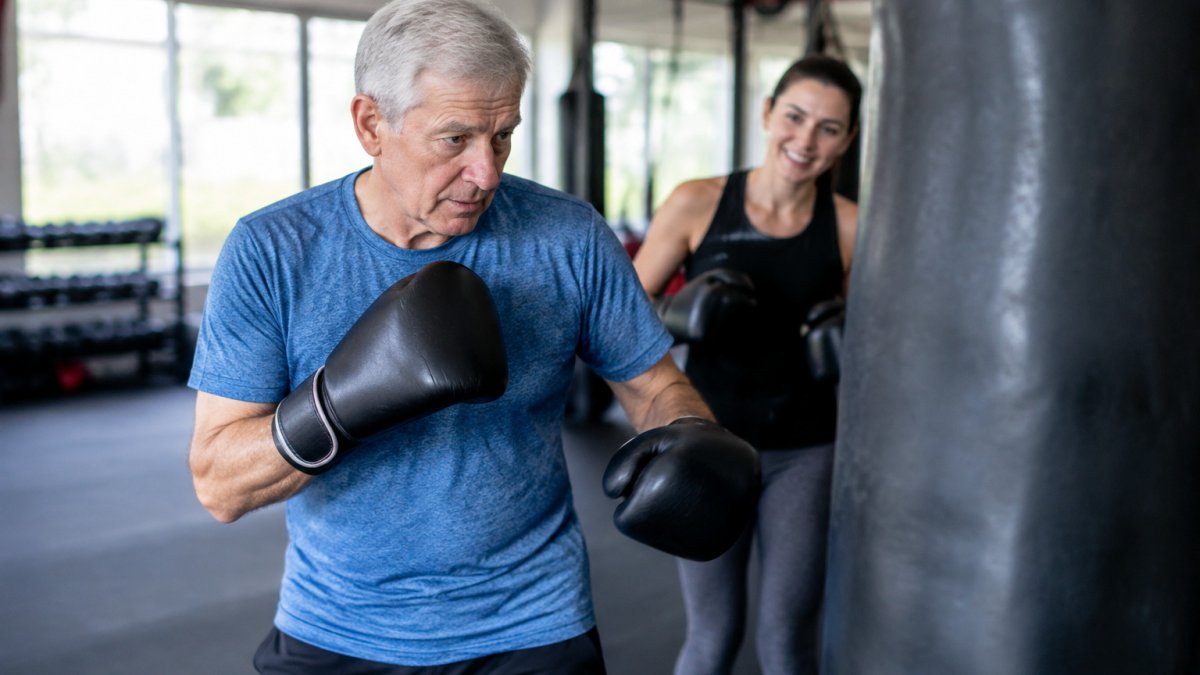
A Parkinson's boxing program is a supervised, non-contact class built around exercises that mirror boxing movements. Sessions typically open with a warm-up, move into footwork and bag or mitt work, include strength and flexibility exercises, and finish with a cooldown.
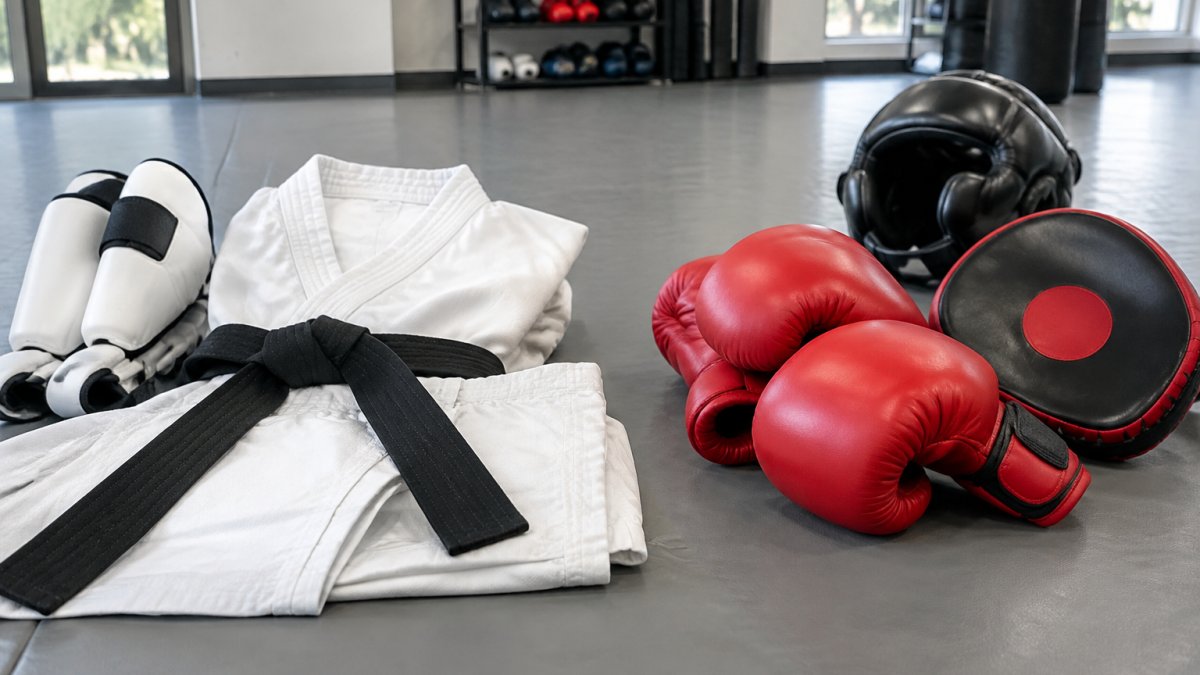
Non-contact is the defining feature. Participants never spar or take hits, and the focus is on form, speed of movement and control. Programs usually use padded equipment such as focus mitts, speed bags and heavy bags, and classes are commonly structured in small groups so coaches can give individual corrections.
What the Research on Boxing and Parkinson's Actually Measures
Most studies of boxing for parkinsons are small, short, and exploratory.
What the studies actually measure matters as much as how big they are. Typical outcomes fall into four buckets:
- Balance and gait: the Berg Balance Scale, Timed Up and Go, gait speed over a short walk, and step length. These are sensitive to change in a few weeks but also fluctuate with medication timing and fatigue.
- Motor severity: the MDS-UPDRS Part III, a clinician-rated motor exam. Scores can improve with practice on the specific tasks tested, which is not the same as global motor improvement.
- Functional and quality-of-life questionnaires: the Parkinson's Disease Questionnaire (PDQ-39), falls diaries, and self-reported confidence with daily tasks. These capture what participants feel but are prone to expectation effects in unblinded studies.
- Feasibility and adherence: attendance rates, dropouts, and adverse events. These are the most consistently reported and the most reliable findings.
A practical reading of the evidence is that non-contact boxing appears feasible and well tolerated by many people with PD, and that participants often show short-term improvements in balance, gait speed, and mood. For a balanced overview of exercise and PD, Parkinson's Foundation exercise guidance is a useful starting point, and the National Institute of Neurological Disorders and Stroke provides context on the disease itself.
Watch out: a single small study with a positive result is not proof of benefit, and a program that cites one study as definitive is overselling. Ask what was measured, over how long, and compared with what.
The studies behind boxing for Parkinson's differ in size, length and what they measure, as summarised below.
| Outcome type | Examples named in the article | What it captures |
|---|---|---|
| Balance and gait | Berg Balance Scale, Timed Up and Go, gait speed | Sensitive to short-term change, but can fluctuate with medication timing |
| Motor severity | MDS-UPDRS Part III | Clinician-rated motor exam; can improve with practice on tested tasks |
| Functional and quality of life | PDQ-39, falls diaries, self-reported confidence | What participants feel; prone to expectation effects in unblinded studies |
| Feasibility and adherence | Attendance, dropouts, adverse events | The most consistently reported and most reliable findings |
Parkinson's Boxing Safety: Screening and Adaptations by Symptom and Stage
Anyone with PD should speak with their neurologist or physician before starting a new exercise program. Because balance can shift with medication timing and other health factors, clinicians and coaches can tailor exercises for balance to a person’s current abilities and safety needs.
Get Started Today at NO RISK! →
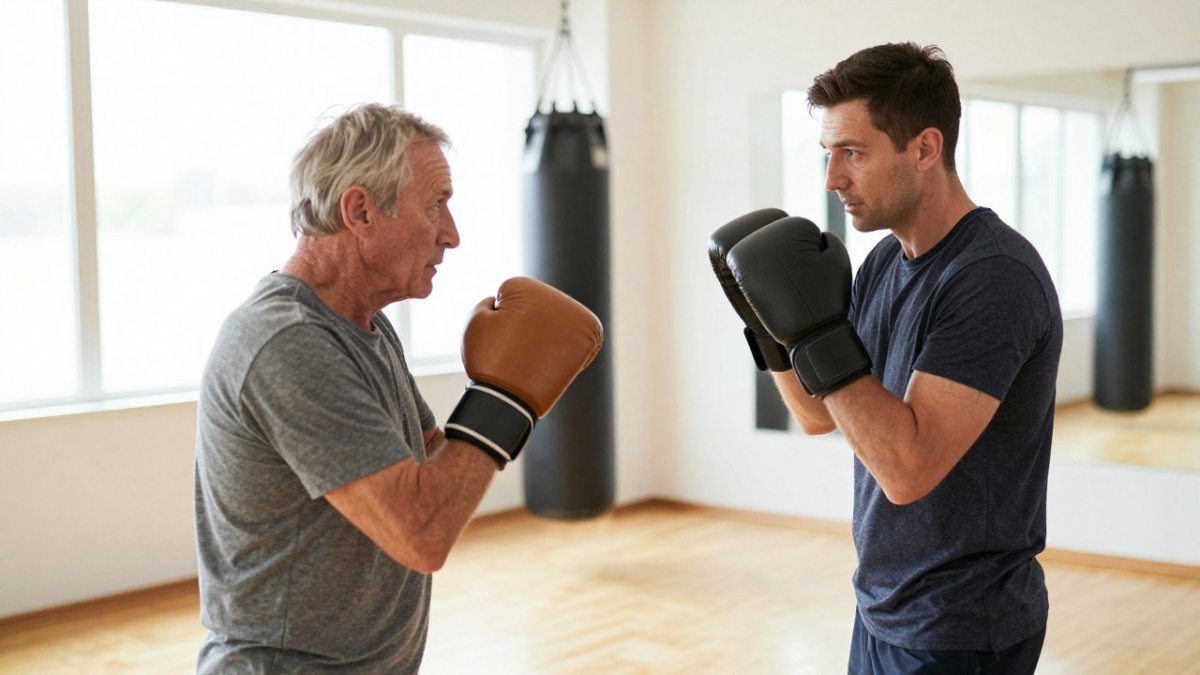
Adaptations should follow the symptom, not just the stage label. A common pattern is to modify one variable at a time: stance width, speed, round length, or support.
- Falls or significant balance loss: work near a wall or sturdy chair, widen the stance, reduce pivots, and substitute seated shadow boxing for standing footwork.
- Freezing of gait: use external cues such as counting, metronome beats, or laser pointers, and practice large stepping with a clear target. Avoid crowded drill lines that force sudden direction changes.
- Fatigue and "off" periods: shorten rounds to 1 to 2 minutes, add seated rest, and schedule sessions when medication is working well. Fatigue that does not resolve with rest is a reason to check with the care team.
- Cognitive changes: keep instructions to one or two steps, demonstrate rather than describe, and pair a coach with each participant in larger classes.
- Cardiovascular or orthopedic conditions: get clearance, cap intensity, and avoid heavy bag work that stresses the shoulders or wrists without padding.
Watch out: dizziness, chest discomfort, a sudden change in gait, or unusual shortness of breath are reasons to stop the session and seek medical advice, not to push through.
Boxing for Parkinson's at Home: Options, Limits and a Beginner Session Plan
Some people with PD want to train at home, either between classes or instead of attending one. At-home work can include shadow boxing while seated or standing near a sturdy support, slow footwork patterns on a marked floor, and light strength work with resistance bands. Keep the area clear of obstacles and have a chair or wall within reach.
A simple beginner session might run 30 to 40 minutes: a five-minute warm-up of marching and arm swings; ten minutes of footwork such as side steps and pivots; ten minutes of shadow boxing with slow, big jabs and hooks; five minutes of balance work near a support; and a five-minute cooldown with stretching. Explore brain-body workouts that pair coordination and cognition with movement. Progress by adding a few minutes or one extra round per week only if the session feels manageable. At-home training has real limits, though: without a coach, it is harder to catch form problems or spot early warning signs of a fall. Use it to supplement, not replace, supervised instruction.
How Boxing Compares With Other Exercise Options, and How to Evaluate a Class
Boxing is one of several options. Tai chi and dance programs also emphasize balance and rhythm, while treadmill walking and cycling emphasize aerobic capacity. Physical therapy addresses specific deficits and is often the right first step after diagnosis. Resistance training builds strength that supports daily tasks.
When evaluating a Parkinson's boxing class, ask whether coaches have specific PD training, how many participants share each coach, whether screening is required before joining, how drills are modified, and whether the class is non-contact. Ask to observe a session.
Choosing Your First Parkinson's Boxing Class in Kingwood
If you are considering a class in Kingwood, start with a conversation with your doctor, then ask a few direct questions of any program you consider. Read the beginner's guide to boxing fitness classes in Kingwood to compare what is available locally. Weigh whether a Rock Steady-style program is effective before committing to a class. People with Parkinson's and their caregivers who want to learn more can contact Battenberg's directly. Masters Jeff and Reneé Battenberg lead our programs.
Frequently Asked Questions
Why is boxing so good for Parkinson's?
Boxing combines footwork, rotation, reaction time and repeated large movements, which target several areas that Parkinson's commonly affects, including balance, posture, gait and coordination. Non-contact programs such as Rock Steady Boxing are designed around these goals. The research so far is promising but limited, with small studies that mostly measure balance, mobility and quality of life rather than long-term disease progression. Boxing is best viewed as a structured form of exercise that supports daily function, not as a treatment that stops Parkinson's.
Can boxing help people with Parkinson's disease?
Studies suggest boxing-style training may improve balance, gait, posture and reaction time in people with Parkinson's, and some participants report better mood and confidence. Results vary by symptom severity and how consistently people train. Boxing works best alongside medical care and any therapy a neurologist recommends. Anyone with Parkinson's should talk with their doctor before starting a new exercise program.
Is boxing safe for people with Parkinson's disease?
Non-contact boxing is generally considered safe for people with Parkinson's when it is supervised and adapted. Coaches should screen for fall risk, orthostatic blood pressure drops, cognitive or vision issues, and joint problems before the first session. Head contact, sparring and heavy bag work that risks losing balance should be avoided. Warm-ups, cooldowns and rest breaks reduce injury risk, and any new dizziness, chest pain or unusual symptoms should prompt a stop and a call to a healthcare provider.
Can people with Parkinson's do boxing exercises at home?
Some boxing movements, such as shadowboxing, stepping drills and light punching combinations, can be practiced at home with a clear floor, sturdy support nearby and a chair for rest. Home practice works best as a supplement to a structured class, because coaches can correct form and adjust intensity. Anyone who is prone to falls should not practice alone and should keep walking aids within reach. Ask a physical therapist or your Parkinson's care team to review a home plan before starting.
How often should someone with Parkinson's do boxing exercises?
Most structured Parkinson's exercise programs meet two to three times per week, with sessions lasting around 45 to 60 minutes including warm-up and cooldown. Consistency tends to matter more than intensity, so a schedule someone can keep for months is more useful than a short burst of hard training. Rest days help with recovery, and the right frequency depends on symptom severity, energy levels and medical advice.
What happens in a Parkinson's boxing class?
A typical session starts with a warm-up of stretching and marching, followed by footwork, balance drills and non-contact punching combinations on pads or in the air. Many classes add reaction-time and cognitive challenges, such as calling out combinations or responding to cues. Sessions end with a cooldown and stretching. Classes are usually small, and coaches adapt movements for participants with different symptoms and abilities.
What other activities can help people with Parkinson's disease?
Aerobic exercise such as walking, cycling and swimming, along with resistance training, flexibility work, tai chi and dance, all have research support for Parkinson's. Speech therapy, occupational therapy and physical therapy also play key roles, especially for voice, hand function and mobility. Combining several types of activity is generally recommended, and the best mix depends on individual symptoms and goals.
Get started with Battenberg's and see how a supervised, non-contact boxing program can fit into your routine. Reach out to our team to learn more about Rock Steady Boxing and our other classes.