 comparison
Neuro-Training vs Traditional Preschool Sports
Last Updated: October 26, 2026
Quick Summary
Neuro-training vs traditional preschool sports comes down to whether you train muscles or the brain that controls them. Neuro-training targets the nervous system to build balance, coordination and focus, while traditional preschool sports teach game skills first through repeated drills. The two approaches are complementary rather than competing.
- Neuro-training targets three sensory systems: vestibular, proprioception and visual-motor integration.
- Well-sequenced programs progress through novelty, consolidation and automaticity over roughly 12 weeks.
- Traditional sports build strong near transfer; neuro-training aims for broader far transfer.
- Neuro-training best fits ages 4-6, while traditional sports suit ages 5 and up.
- Poorly designed neuro-training that adds complexity weekly can over-stimulate preschoolers.
Table of Contents
- Neuro-Training vs Traditional Preschool Sports: The Core Difference
- What Preschool Sports Benefits Actually Look Like on the Ground
- How Neuro-Fitness for Kids Rewires the Brain Through Movement
- Motor Skills Activities for Preschoolers: What Each Approach Delivers
- Age-Appropriate Sports for Preschoolers: A Side-by-Side Comparison
- Safety, Over-Stimulation, and What to Watch For
- Choosing the Right Fit for Your Family in Kingwood
- Frequently Asked Questions
Neuro-Training vs Traditional Preschool Sports: The Core Difference
Neuro-training vs traditional preschool sports comes down to one question: are you training muscles or the brain that controls them? Neuro-training is a movement method that targets the nervous system itself, building the neural connections behind balance, coordination, and focus.
That distinction matters more than most parents realize. A four-year-old who learns to dribble a ball has practiced a specific skill.
Below, we break down what each approach actually delivers, where the risks sit, and how to choose.
What Preschool Sports Benefits Actually Look Like on the Ground
Ask most parents what they want from preschool sports and you'll hear the same things: better coordination, more confidence, an outlet for all that energy.
The practical difference shows up in skill acquisition. A child in a traditional soccer program learns to kick a ball toward a goal.
For families weighing a switch after a sports dropout, martial arts for kids who quit sports covers how that transition usually goes.
How Neuro-Fitness for Kids Rewires the Brain Through Movement
Neuro-fitness for kids is the deliberate use of movement to strengthen neural connections during the years when the brain is most adaptable. The mechanism is neuroplasticity: every time a child practices a new movement pattern, the brain builds and refines the pathways behind it. Repetition locks those pathways in.
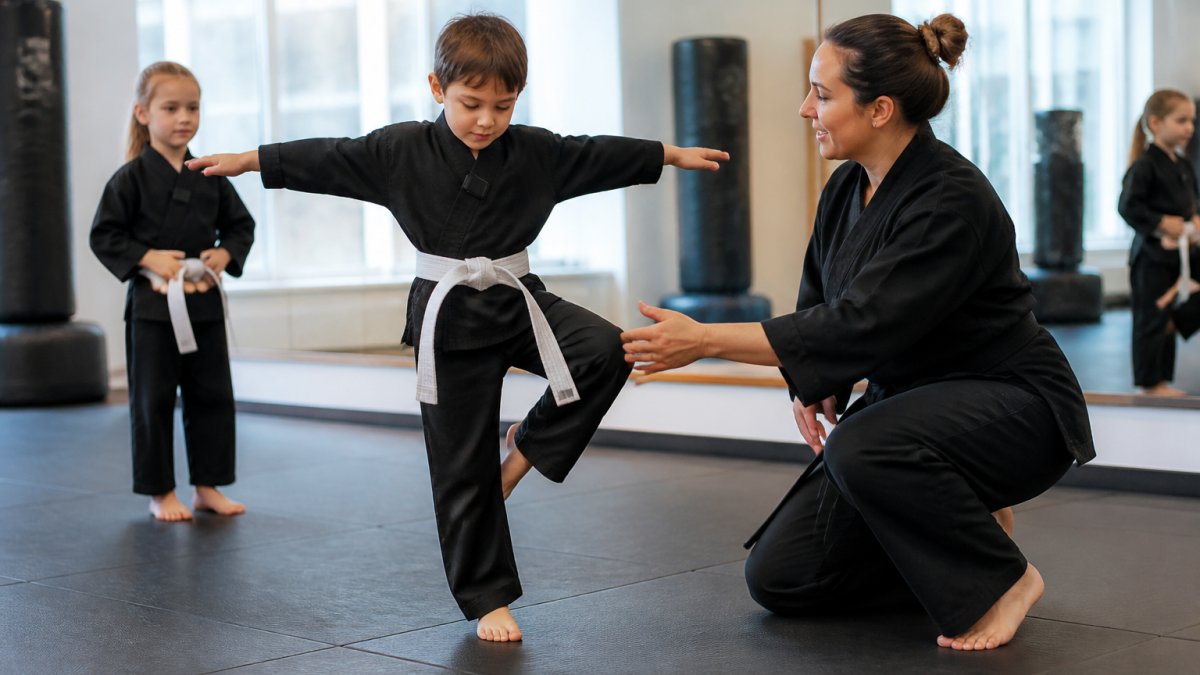
The three sensory systems neuro-training targets first
Most preschool neuro-training programs are built on three systems that mature rapidly between ages 3 and 7:
- Vestibular system (balance and head position). Balance drills, standing on one leg, walking a line, controlled spins, train the inner ear to report head position accurately. A well-functioning vestibular system is the foundation for stable vision and posture, which is why occupational therapists screen it before handwriting work.
- Proprioception (body awareness). Crossing-body movements, animal walks, and resistance games teach the brain where limbs are without looking. This is the system behind 'knowing where your body is in space,' and it underlies safe landing, catching, and sitting still.
- Visual-motor integration (eye-hand and eye-foot coordination). Tracking a moving object, adjusting body position mid-movement, and correcting errors in real time train the brain to pair visual input with motor output. This is the same loop used in reading (tracking left to right) and handwriting (guiding a pencil).
What neuroplasticity actually looks like month by month
Neuroplasticity is not a switch; it is a curve. Most practitioners find that preschool-aged children show a predictable progression when a program is well sequenced:
- Weeks 1-4: Novelty and error. New patterns produce visible wobble and frequent self-correction. The brain is recruiting attention to the task, which is why young children look intensely focused and tire quickly.
- Weeks 5-8: Consolidation. The same drills become smoother and require less conscious effort. This is the period when myelination, the fatty insulation around nerve fibers, is thought to speed signal transmission along repeatedly used pathways.
- Weeks 9-12: Automaticity and transfer. The skill becomes 'background' enough that the child can layer a second task on top (catch while balancing, kick while tracking). This is when parents typically report spillover into focus at home and in the classroom.
A program that skips the consolidation phase, adding complexity every week, short-circuits this curve. That is the single most common design flaw in neuro-training for preschoolers, and it is why the safety section below matters.
The executive-function connection
What most guides miss is that this is not abstract. Balance drills train the vestibular system. Crossing-body movements train coordination between the brain's hemispheres. The National Institutes of Health framework behind this is well established, and the CDC's developmental milestones for ages 4-5 describe the observable markers, hopping on one foot, catching a bounced ball, copying shapes, that map directly onto these systems.
For a deeper look, our guide to martial arts for focus in kids walks through the classroom connection, and 7 ways to help your child focus in school gives parents practical tools to reinforce it at home.
Motor Skills Activities for Preschoolers: What Each Approach Delivers
Motor skills activities for preschoolers fall into two buckets, and the bucket matters more than the specific activity. Traditional sports lean on closed drills: a set kick, a set throw, a set path. Neuro-training leans on open drills that force the brain to solve a movement problem each time.
Here is how the two approaches compare on the outcomes parents care about.
| Outcome | Traditional Preschool Sports | Neuro-Training Approach |
|---|---|---|
| Primary target | Game-specific skill | Nervous system and movement patterns |
| Drill style | Repetition of a fixed motion | Variable, problem-solving movement |
| Near transfer | Strong within the same sport | Strong across many physical tasks |
| Far transfer | Limited | Broader, especially for focus and memory |
| Cognitive load | Low to moderate | Deliberately progressive |
| Best age window | Ages 5 and up | Ages 4-6, when plasticity peaks |
| Typical weekly commitment | 1-2 sessions, often seasonal | 1-2 sessions, often year-round |
| Parent visibility | Game-day performance | Movement-quality progress notes |
Near transfer vs. far transfer, in plain terms
Near transfer means getting better at the exact skill you practice. A child who practices kicking a stationary ball gets better at kicking a stationary ball. Far transfer means improvement spilling into unrelated areas like attention and problem-solving. Traditional sports are excellent at the first.
The mechanism is straightforward: closed drills rehearse one motor program, so the gain stays tied to that program.
What each approach actually looks like in a 45-minute class
Traditional preschool sports (soccer, T-ball, gymnastics):
Get Started Today at NO RISK! →
- Warm-up jog and stretch (5 minutes)
- Station drills, dribble through cones, kick at a target, throw to a partner (20 minutes)
- Small-sided game or scrimmage (15 minutes)
The child practices the same motion many times. Coaching cues are sport-specific ('plant your foot, lock your ankle').
Neuro-training (martial arts, movement education, sensory-based programs):
- Vestibular warm-up, balance holds, animal walks, controlled rolls (10 minutes)
- Crossing-body and coordination patterns, opposite-hand-to-knee touches, mirror drills (10 minutes)
- Reaction and tracking games, catch while balancing, respond to a signal with a specific movement (15 minutes)
Coaching cues are body-awareness cues ('feel your weight shift, find your center'). The child practices solving movement problems, not repeating one solution.
Which approach fits which child
There is no universal winner, and the honest answer is that the two approaches are complementary. A few practical rules:
- Choose traditional sports first if your child is 5 or older, already asks about a specific sport, and thrives on game-day structure. The social and emotional benefits of team play are real and hard to replicate.
- Choose neuro-training first if your child is 4-6, shows sensory-seeking or sensory-avoiding behavior, struggles with focus or transitions, or has dropped out of a traditional sport because the pace or pressure did not fit.
- Choose both if the schedule allows. A neuro-training class one day a week plus a recreational team sport on the weekend gives the child both the broad sensory base and the sport-specific fun.
Parents who want to compare a specific preschool martial arts track against traditional sports can read our Taekwondo classes for preschoolers guide for the full breakdown.
Age-Appropriate Sports for Preschoolers: A Side-by-Side Comparison
Age-appropriate sports for preschoolers should match the child's developmental stage, not the sport's popularity.
A simple rule: the younger the child, the more the program should look like movement education and the less it should look like a miniature version of an adult sport.
Parents who want to compare a specific preschool martial arts track against traditional sports can read our Taekwondo classes for preschoolers guide for the full breakdown.
Safety, Over-Stimulation, and What to Watch For
Safety in preschool movement programs is mostly about load management, and this is where neuro-training carries a real caveat.
Watch out: a program that treats neuro-training as a race, adding complexity every week without consolidating the basics, can leave a preschooler fatigued and frustrated rather than sharper.
On the traditional side, the common risk is repetitive strain from too much of one motion and early specialization.
Choosing the Right Fit for Your Family in Kingwood
The right program is the one your child will attend consistently, with coaches who understand how young brains learn. For families in the Kingwood area, that means looking past the brochure and asking three questions: Does the coach explain the why behind each drill?
Our Pre-Karate Kub program for ages 4-6 was built around exactly those questions, with neuro-training development folded into every session and instruction led by Masters Jeff and Reneé Battenberg. If you are ready to see it in person, here is how to book a martial arts trial class step by step.
The hardest part of choosing between neuro-training and traditional preschool sports is that both can work, and the difference only shows up months later in how your child moves, focuses, and handles frustration.
Frequently Asked Questions
What is neuro-training for preschoolers?
Neuro-training for preschoolers is a movement-based approach that targets brain development alongside physical fitness. It uses drills that challenge balance, coordination, proprioception, and sensory integration to build neural connections during the critical ages of 4 to 6. Unlike traditional sports that focus mainly on game rules and basic athletic skills, neuro-training deliberately sequences movements to improve focus, memory, and emotional regulation. Programs like Battenberg's Pre-Karate Kub incorporate these principles into martial arts instruction.
How is neuro-training different from traditional preschool sports?
Traditional preschool sports typically emphasize sport-specific skills like kicking a ball or running bases, with less attention to underlying brain development. Neuro-training vs traditional preschool sports differs in that neuro-training prioritizes neuromuscular patterns, sensory integration, and cognitive load management before layering on sport skills. The result is often better focus, coordination, and transfer of skills to other activities. Both have value, but neuro-training targets the brain-body connection more directly during the preschool years.
Can preschoolers benefit from doing both neuro-training and sports?
Yes. Many families combine neuro-fitness for kids with traditional preschool sports benefits. Neuro-training builds the foundational motor skills and cognitive pathways that make sport participation easier and more enjoyable. A child who has practiced balance, proprioception, and focus drills can often pick up soccer or t-ball faster. The key is balancing structured neuro-training with free play and not overloading a young child's schedule with too many organized activities.
At what age can children start organized sports?
Most children can start structured, age-appropriate sports for preschoolers around ages 4 to 6, when they have enough attention span and motor control to follow simple instructions. Before age 4, free play and basic movement exploration are usually more beneficial. Neuro-training programs designed for preschoolers, such as Battenberg's Pre-Karate Kub, are built specifically for this 4-to-6 window and focus on brain development alongside physical skills, making them a strong starting point.
How can parents choose a physical activity that suits their preschooler?
Start by observing your child's temperament and energy level. A child who thrives on structure may enjoy a neuro-training class, while one who prefers free movement might do better with a less structured motor skills activities for preschoolers program. Visit a class before committing, ask about coach-to-child ratios, and check whether the program accounts for safety and over-stimulation risks. In the Kingwood area, Battenberg's offers a no-risk way to try their Pre-Karate Kub program.