 blog
Top 5 Martial Arts for Cognitive Development in Kids
Last Updated: November 21, 2026
Quick Summary
The top 5 martial arts for cognitive development in kids are Taekwondo, Brazilian Jiu-Jitsu, Karate, Judo, and Tai Chi. Each style trains attention, working memory, and self-control differently, so choose one your child will attend consistently.
- Taekwondo ranks first because it combines attention, working memory, and inhibition in one class.
- Brazilian Jiu-Jitsu trains working memory under load and rewards calm thinking over force.
- Karate builds working memory through kata and executive function through class ritual.
- Judo trains decision speed, reaction time, and motor planning through throws and balance work.
- Tai Chi offers a lower-stimulation entry point that builds sustained attention and calm.
Table of Contents
- How Martial Arts Build Cognitive Skills in Children
- 1. Taekwondo: The Complete Cognitive Package
- 2. Brazilian Jiu-Jitsu: Grappling With Working Memory
- 3. Karate: Forms, Focus, and Executive Function
- 4. Judo: Balance, Reaction Time, and Decision-Making
- 5. Tai Chi: The Mind-Body Option for Attention and Calm
- Martial Arts and Working Memory: What Parents Should Know
- The Best Martial Arts for Kids With ADHD
- Frequently Asked Questions
How Martial Arts Build Cognitive Skills in Children
The top 5 martial arts for cognitive development combine physical movement with mental demand, and the strongest options for children are Taekwondo, Brazilian Jiu-Jitsu, Karate, Judo, and Tai Chi. Each style trains attention, working memory, and self-control in a different way, which matters because the mental workout is what separates martial arts from most youth sports.
Parents often ask the same question: which style actually helps my child think better, not just move faster? For a broader practical guide on using martial arts to build focus in kids, start there. Readers who want the overall benefits picture for kids, focus, fitness, and confidence, can start with that overview before diving into specific styles.
Below, we rank five styles specifically for cognitive outcomes, explain the mechanism behind each, and show you how to judge a class before you enroll. We also cover what the research can and cannot prove, because that honesty matters when you are choosing a program for a five-year-old.
What the Research Says About Martial Arts and the Brain
Exercise in general supports brain health, and the Centers for Disease Control and Prevention physical activity guidance notes that regular physical activity benefits brain health across the lifespan.
Cognitive development is the growth of mental skills such as attention, memory, and problem-solving over time. Martial arts touches all three because a child cannot throw a clean kick while distracted, and cannot spar without tracking an opponent's next move.
The honest caveat: much of the research on martial arts and cognition is small-scale and often studies adults or older adults.
The Limits of the Evidence
No credible body of research shows that any single martial art produces superior brain gains in children. Studies often mix ages, styles, and training durations, and few follow children over multiple years.
What the evidence does support is narrower and more useful: structured physical activity with attention demands tends to help children practice focus and self-regulation. Parents comparing brain-based training approaches can read more in our breakdown of neuro-training versus traditional preschool sports.
The practical takeaway is to choose a style your child will actually attend consistently. A modest program attended for years beats a perfect program abandoned in six weeks.
Here is a quick comparison of the five styles and the cognitive skills each one trains.
| Style | Cognitive focus | Best for | Skip if |
|---|---|---|---|
| Taekwondo | Attention, working memory, inhibition together | Kids needing help with focus and multi-step instructions | Child shuts down under performance pressure |
| Brazilian Jiu-Jitsu | Working memory under load, calm thinking | Kids who think through problems and need a physical outlet | Child uncomfortable with close physical contact |
| Karate | Working memory via kata, executive function | Kids who like clear structure and measurable progress | Child needs constant variety |
| Judo | Decision speed, reaction time, motor planning | Active kids who need to learn control and safe landing | Child dislikes being thrown or grabbed |
| Tai Chi | Sustained attention and mind-body control | Anxious children or kids who need help settling attention | Child craves fast action |
1. Taekwondo: The Complete Cognitive Package
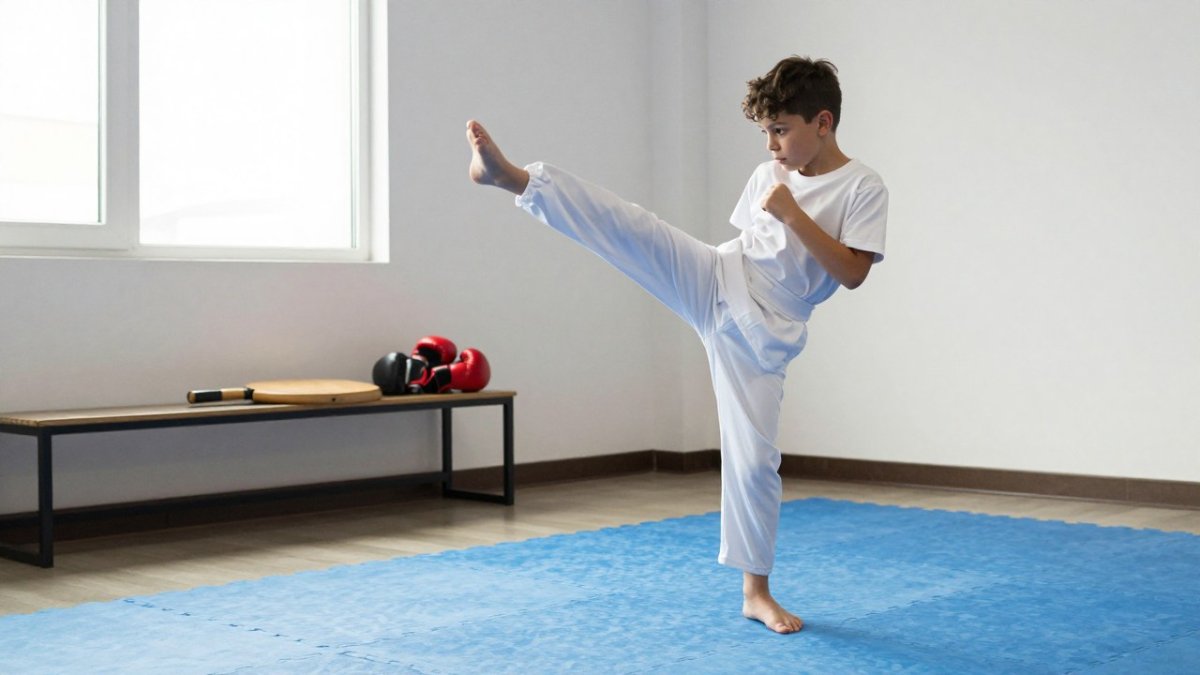
Taekwondo ranks first because it stacks three cognitive demands into one class: fast visual tracking during kicking drills, memorized forms called poomsae, and sparring that requires reading an opponent in real time. That combination hits attention, working memory, and inhibition together rather than training one skill in isolation.
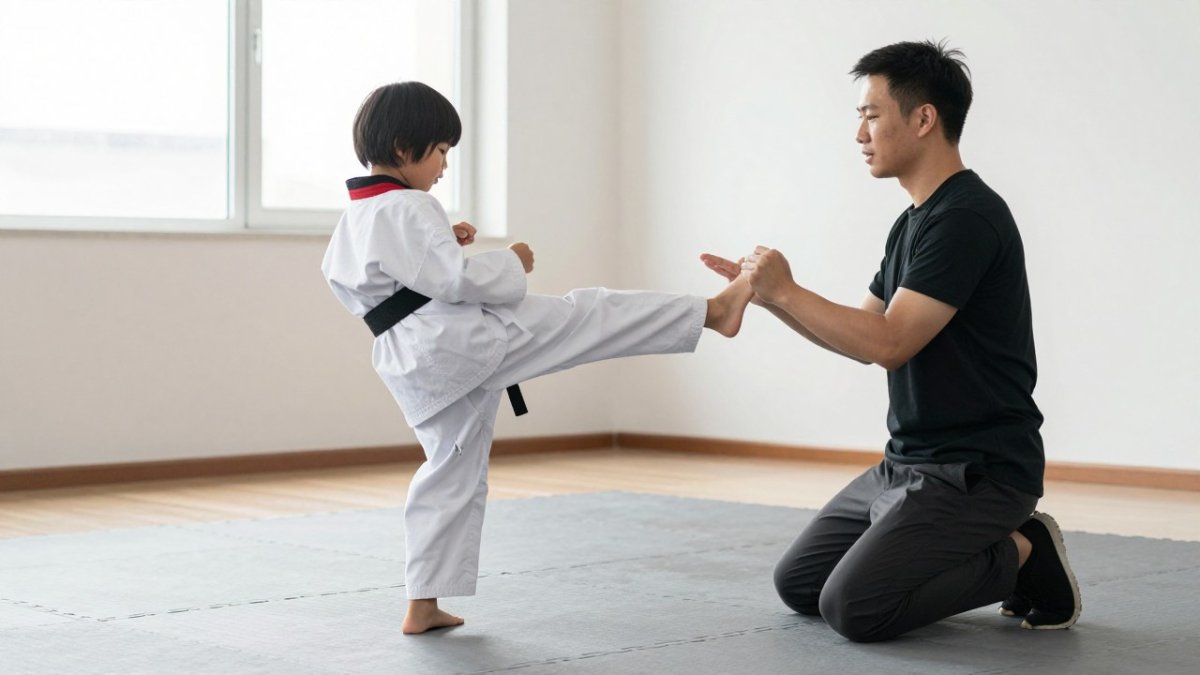
The mechanism is worth spelling out.
The style's emphasis on controlled technique can also support self-control, since a child learns that power is most useful when it stops on command.
Age matters here. For a five-year-old, look for a program built around short drills, simple sequences, and lots of encouragement rather than competition.
If you have already settled on Taekwondo, the next step is simple: book a trial class and watch how your child responds to the structure.
2. Brazilian Jiu-Jitsu: Grappling With Working Memory
Brazilian Jiu-Jitsu is a grappling art, and grappling is a memory game played at speed.
The style also removes striking from the equation, which reassures parents worried about aggression. Live training, called rolling, happens with control and constant coaching.
What most guides miss is how much BJJ rewards calm thinking. A panicked child burns energy and gets stuck. A calm child works through options. That is inhibition training in a very literal sense.
Best for: Kids who think their way through problems and need a physical outlet. Skip if: Your child is uncomfortable with close physical contact; give it a few weeks before deciding.
3. Karate: Forms, Focus, and Executive Function
Karate's kata, the choreographed forms at the heart of the style, are a working-memory treadmill. A child memorizes a long sequence of strikes, blocks, and turns, then performs it without prompts.
Karate also suits a wide age range. A five-year-old can learn short forms, while an older child can handle longer sequences and light sparring.
Best for: Children who like clear structure and measurable progress. Skip if: Your child needs constant variety; traditional classes can feel repetitive.
4. Judo: Balance, Reaction Time, and Decision-Making
Judo is the throw-and-balance style, and its cognitive signature is decision speed. That quick choice also asks children to stay composed, respect a partner, and take responsibility for their actions, linking the mental demands of judo with the discipline and character emphasized by Teamusataekwondo.
Balance work is constant. Every throw begins with breaking someone else's balance while keeping your own, which demands coordination and body awareness. Children who struggle with clumsiness often find judo builds control quickly.
The sport also teaches safe falling, a skill that pays off in everyday life. Parents often report that judo makes their child more confident in physical space, though the strongest evidence remains the structured practice itself rather than any single claim.
Best for: Active kids who need to learn control and safe landing. Skip if: Your child dislikes being thrown or grabbed; try a striking art instead.
5. Tai Chi: The Mind-Body Option for Attention and Calm
Tai Chi is the slowest style on this list, and that is the point. The practice pairs breathing with deliberate movement sequences, which trains sustained attention and mind-body control.
For anxious or highly energetic children, Tai Chi offers a lower-stimulation entry point. It teaches concentration without the noise and contact of sparring, and many instructors adapt the forms for school-age children.
The trade-off is real: Tai Chi builds calm focus but offers less explosive strength and reaction training than the other four styles. For a child who needs to learn to slow down before speeding up, that is a fair exchange.
Best for: Anxious children or kids who need help settling their attention. Skip if: Your child craves fast action; they will likely find it boring.
Martial Arts and Working Memory: What Parents Should Know
Working memory is the mental workspace where a child holds information while using it, and martial arts drills it constantly. Remembering a three-move combination, tracking a partner's position, and recalling a coach's correction all load that workspace.
Parents can support this at home without turning practice into homework. Ask your child to teach you one move from class. Explaining a sequence out loud forces recall and strengthens the memory trace.
Progress is not only measured by belt rank. Watch for smaller signals: your child waits their turn more patiently, follows two-step instructions at home, or recovers faster after a mistake.
How to Evaluate a Class Before You Enroll
This is the part most articles leave out, and it is where the real decision gets made. Use this checklist when you visit a school:
- Instructor training and background. Ask what certification or rank the instructors hold, whether they have training in child development or coaching, and whether the same instructor teaches every class your child would attend. Consistency matters because a rotating staff cannot track your child's progress.
- Class structure and drill length. For younger children, look for short stations and frequent changes of activity. Long lines and extended lectures give a child little actual practice. Ask how many reps each child gets in a typical class.
- Feedback style. Immediate, specific correction ('plant your back foot before you kick') builds skill; vague praise ('good job') does not. Watch whether instructors correct the same child twice in a row or move on.
- Safety practices. Padded floors, age-matched partners, clear rules about contact, and a stated policy for injuries are baseline. Ask how the school handles a child who is overwhelmed or wants to stop mid-drill.
- Progressive skill learning. A good program has a visible path: what a child learns in month one, month six, and year two. Ask to see the curriculum outline rather than relying on belt colors alone.
- Fit for your child's temperament. A high-energy child may thrive in a fast striking class; a cautious child may do better starting with forms or a calmer style. Ask whether you can observe a full class before committing.
Safety deserves a mention too. Look for padded floors, trained instructors, age-matched partners, and clear rules about contact. A good school teaches children to tap out or speak up the moment something feels wrong.
When you are ready to act on what you have learned, our guide to choosing a martial arts school covers what to ask before you enroll.
The Best Martial Arts for Kids With ADHD
For children with ADHD, the best martial arts are the ones with frequent feedback and short drill cycles: Taekwondo and Brazilian Jiu-Jitsu are often suggested for this reason.
Structure is the real medicine. A predictable warm-up, clear rules, and immediate correction give a child with ADHD a reliable script to follow.
Talk to instructors before enrolling. Ask how they handle a child who loses focus mid-drill, and whether they use short stations or long lines.
Every child's brain responds differently, and the only way to know which style fits yours is to watch them try it.
Frequently Asked Questions
Which martial art is best for a child with ADHD?
Taekwondo and Brazilian jiu-jitsu tend to work well for kids with ADHD because both combine short, structured drills with clear rules and immediate feedback. Taekwondo's pattern practice trains sustained attention, while jiu-jitsu's grappling sequences demand constant working memory updates. The best martial arts for kids with ADHD share three traits: predictable routines, small class sizes, and instructors who give frequent specific corrections. Visit a class first and watch how the instructor handles a distracted child before you commit.
Do martial arts actually improve memory and attention?
Studies on martial arts and working memory suggest real but modest gains. Research on school-age children in karate and taekwondo programs has found improvements in selective attention and inhibition compared with inactive peers. The effects are strongest when training happens two or more times per week over several months. Treat these as supporting benefits rather than a cure: martial arts cognitive development works best as part of a broader routine that includes sleep, reading, and free play.
What is the safest martial art for a young child's brain?
Tai chi and traditional karate carry the lowest head-impact risk because they emphasize forms, balance, and controlled movement over contact sparring. Martial arts safety for children starts with asking whether sparring is optional and whether head contact is allowed before age 12. Look for padded floors, certified instructors, and a school that separates contact drills by age and experience. Any program that puts young children in full-contact sparring without headgear and strict supervision is a red flag.
Is a 5-year-old ready for martial arts classes?
Many 5-year-olds are ready for a beginner program built around games, short drills, and basic stances. The best martial arts for a 5-year-old focus on listening skills, following two-step directions, and body control rather than sparring or complex techniques. Look for classes of 30 to 45 minutes with a low student-to-instructor ratio. Programs that blend movement with cognitive challenges, like memory games and pattern recall, give your child a head start on focus and self-control.